

Coal Inspectorate | Alert | No.477 V 1 | 18 June 2026
ANIMATION: Coal mine worker injured by shuttle car
Summary
- A coal mine worker was struck by a shuttle car in a serious line of fire incident.
- The worker was not seriously injured. However, this incident could have been fatal.
- RSHQ has released an animation of the incident and is urging mines to assess their sites for related risk and consider introducing proximity detection technology.
- Concerningly, it bears similarities to a previous Queensland underground mining fatality in 2007.
Issue Explained
- A continuous miner operator and cable handler were working at a bord and pillar operation in Central Queensland alongside two shuttle car operators.
- The panel they were working on was in a cut and flit phase. The workers had just completed the previous sequence and had flitted the continuous miner to the next sequence near an intersection.
- The next cutting sequence was in close proximity to the bootend, with minimal travel distance for both shuttle cars.
- During this manoeuvre, the continuous miner struck the lefthand side rib and damaged the ratchet strap holding the rib protection bollards in position.
- The continuous miner operator and cable handler had walked to the offside corner of the machine to inspect the damage.
- At the same time, a shuttle car was at the breaker feeder unloading. The shuttle car operator was not aware the two coal mine workers had moved.
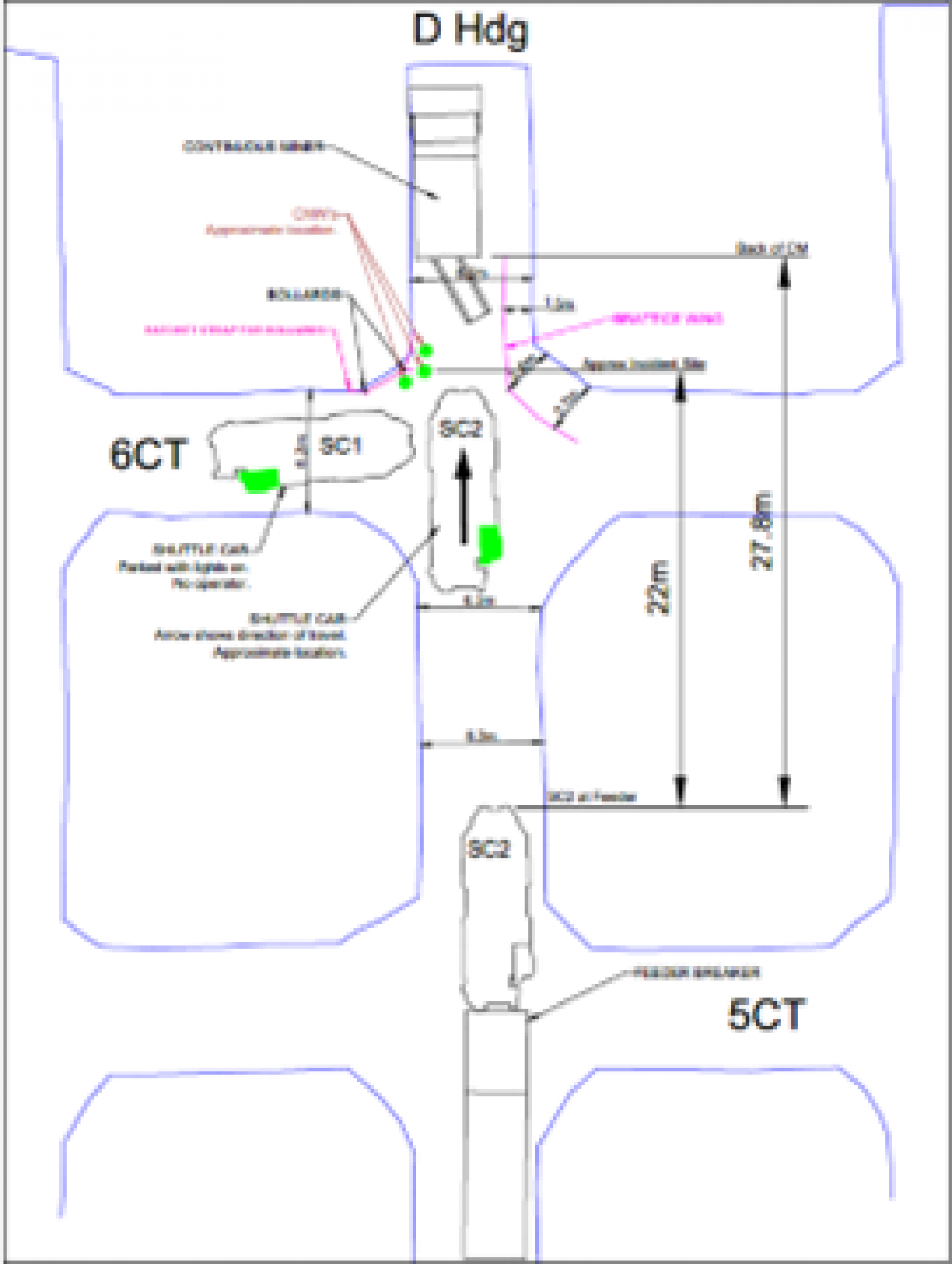
- Without realising the workers’ changed position, the shuttle car operator drove 22 m toward the continuous miner and struck the cable handler.
- The shuttle car knocked him over and he fell onto the continuous miner operator. Luckily, the shuttle car stopped just short of running over the cable handler’s legs.
- Paramedics assessed the workers and one was taken for further assessment. No one was seriously injured.
- Another shuttle car (SC1, per Figure 1 below) was shunted in the cut through close to the intersection, off the moving shuttle car’s (SC2) wheeling road. While it was not in the line of fire, its headlights were on and facing the continuous miner, which impacted visibility.
- Initial investigations show several potential contributing factors to this incident, including:
- Line of fire: The coal mine workers put themselves in the line of fire by standing in the shuttle car’s blind spot to inspect the damage to the ratchet strap.
- Proximity systems: The site did not have proximity systems fitted to coal cutting equipment. Other sites in Queensland have successfully used proximity technology to mitigate shuttle car risk.
- Communication: Without positive communication or verbal warnings, workers changed positions and moved into the shuttle car’s blind spot. In normal, planned production, this would be the ‘no go zone’.
- Blind spots: An accumulation of coal build-up caused by the typical shuttle car design limited the line of sight of the operators standing at the bollards. While this may have contributed to this incident, shuttle cars are, by design, known to have extensive blind spots and this risk needs to be managed.
- Alarm systems: The shuttle car tramming alarm, or ‘banshee alarm’ is the same sound as the prestart alarms on the breaker feeder and continuous miner. The banshee alarm also only sounded twice in 11 seconds and stopped when the operator lifted their foot off the drive peddle, despite the shuttle car continuing to move forward.
- Lighting issues: The other shuttle car’s (SC1) lights were on full beam, illuminating the intersection and limiting the effectiveness of the moving shuttle car’s lights. When SC1 flooded the area with light, it reduced contrast and meant the other shuttle car’s approach did not create the usual moving-light shadow workers often first notice. The continuous miner did not have operation lights fitted at the rear, which would have also helped the shuttle car operator know if it was ready to load.
- Sound: The background noise of the conveyor belt system and breaker feeder also masked the sound of the alarms, and, during a reenactment of the incident, it was difficult to identify the proximity of the moving shuttle car as it approached the continuous miner.
- Cameras: Additional engineering controls, such as cameras, were not in place. The shuttle cars did not have standard, or AI recognition cameras, or infrared camera systems fitted.
- Raised tail: The tail of the continuous miner was raised by 300 mm and bias to the right-hand side of the bord, indicating it was ready to start loading.
Learnings
Sites should take action to protect workers by reducing risk to as low as reasonably achievable.
Following this incident, all Senior Site Executives (SSE) should:
- Assess development operations and bord and pillar operations for this hazard. The risk profile can increase depending on the panel layout and mining methods applied.
- Review critical controls for shuttle car operations.
- Establish blind spot maps for all mobile plant and integrate into no go zones systems.
- Consider using proximity systems as a method to reduce risk related to shuttle car operation. Other mines in Queensland have introduced this technology with success.
- Evaluate additional engineering controls for operations such as camera systems, particularly AI or infrared camera systems.
- Consider fitting operation mode lights at the rear of continuous miners to give shuttle car drivers an indication if it is ready to load or not.
- Reassess expectations for positive communications, particularly when unplanned or ad hoc work must occur in wheeling roads.
- Review the timing and frequency of banshee alarms for shuttle car tramming and consider an independent sound to differentiate it clearly from other pre-start alarms.
Watch an animated recreation of the incident
RSHQ issues Safety and Health Alerts to highlight serious incidents, raise awareness of risks and prompt assessment of existing controls.
Investigations are ongoing. Information within this Safety and Health Alert is accurate at the time of publishing and further detail may be released as investigations progress.
References and further information
- Coal Mining Safety and Health Act 1999 - Sections 6, 7, 37, 38.
- Coal Mining Safety and Health Regulation 2017 - Plant, Division 1 Fixed and Mobile Plant (Part 10)
- Office of the State Coroner findings of inquest: Inquest into the death of Jason George Elliot Blee.
Contact: QldMinesInspectorate@rshq.qld.gov.au
Issued by Resources Safety & Health Queensland
Placement: Place this announcement on noticeboards and ensure all relevant people in your organisation receive a copy.
Find more Safety and Health Alerts
Search the hazards database